
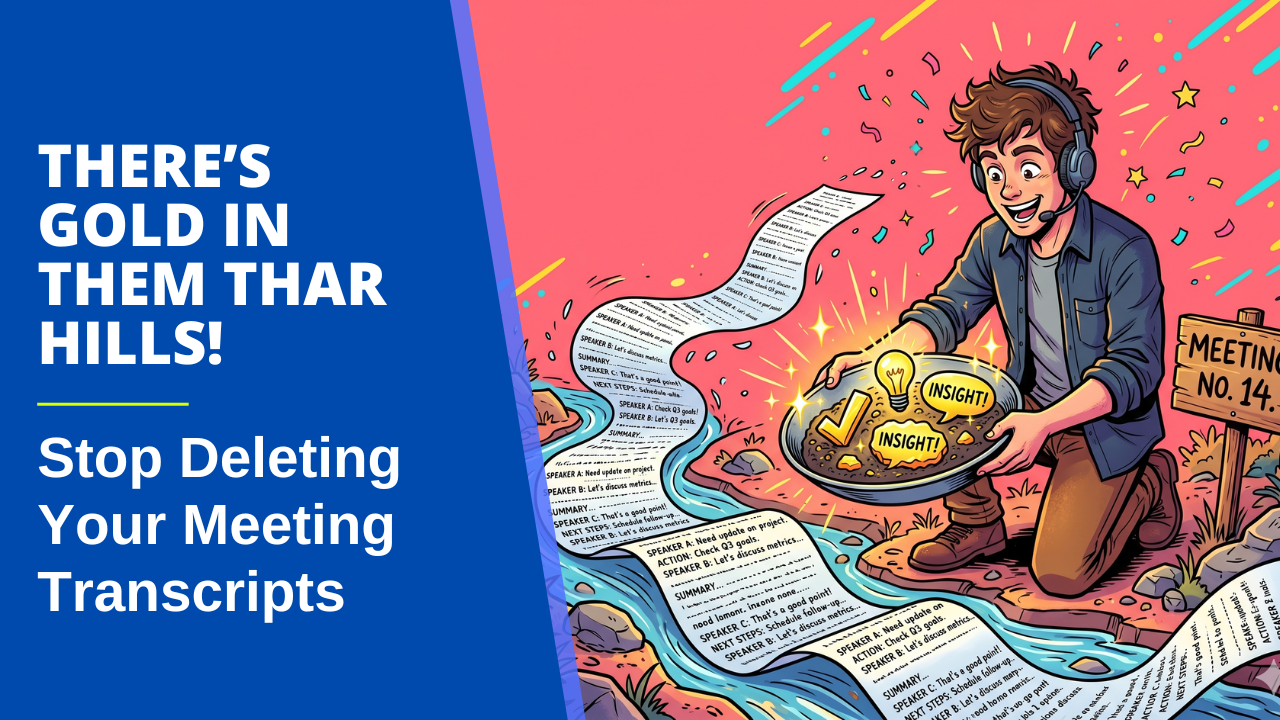
Nobody ever reads a 90-minute meeting transcript.
That’s not a criticism. It’s just true. A transcript of a typical project coordination meeting is thousands of words of crosstalk, throat-clearing, tangents about the weather, and someone asking, “Can everyone see my screen?” Somewhere in there are the five decisions and eight action items that actually matter.
This is why we invented meeting minutes. Someone sits down after the meeting, extracts the important stuff, and throws the rest away. The transcript, if it ever existed, gets deleted or buried in a folder nobody opens again.
For most of the history of the profession, that was the rational move. Raw transcripts were write-only data. Too long to read, too messy to search, too expensive to process. So we kept the refined product and discarded the ore.
AI flipped that math, but many firms haven’t noticed yet.
Low-grade ore, suddenly worth mining
Here’s the thing about gold mining: it’s not about picking up nuggets off the ground. Modern mining is about processing enormous quantities of low-grade ore to extract small amounts of valuable material. The ore was always there. What changed was the processing equipment, which made extraction economical.
Meeting transcripts are low-grade ore. Maybe 95% filler, 5% decisions, commitments, requirements, and context. Before AI, extracting that 5% required a human to read the whole thing, which nobody was going to do. Now, an LLM can process an hour of conversation in seconds, and it never gets bored on page 14.
That means the transcript itself, not the summary, is now the asset. The summary you write the day of the meeting captures what seemed important that day. The transcript captures everything, including what you won’t know is important until three weeks later.
I’ve been watching students in my Claude Workflows for Architects course figure this out in real time, and the use cases sort themselves into three tiers. Each one mines the same ore for progressively more valuable material.
Panning the stream: one transcript, many outputs
The entry point to realizing the value of transcripts is obvious: stop writing minutes from scratch.
One student in the Claude Workflows course, a managing partner at a mid-sized firm, built a workflow around his firm’s diary-style minutes, in which numbered items carry forward from meeting to meeting until they’re resolved. He’d tried the AI note-takers built into the meeting platforms and found them either too wordy or too generic to be useful. His fix was to skip the vendor’s pre-chewed summary and feed Claude the raw transcript along with the prior meeting’s minutes and his firm’s format. He estimates the workflow saves 40 to 60 percent of the time, and the capture is more thorough and consistent than his manual notes ever were.
That last part matters more than the time savings. Minutes written by a human reflect what that human noticed. Minutes mined from a transcript reflect what was actually said.
The same transcript can produce different outputs for different audiences. Another student feeds his weekly meeting transcripts through a skill that generates a one-page prep summary, just for himself, before the next session. Same ore, different refinement. A third pairs the transcript with the attendance list so Claude can verify who said what, thereby fixing the speaker misattribution that plagues auto-generated summaries.
Following the vein: the transcript as project record
The second tier is where it gets interesting. Once you stop deleting transcripts and start storing them somewhere AI can reach, they become part of the project record.
I do this on my own consulting work. Every weekly meeting is transcribed, and the transcript is added to the Claude project for that engagement. I use it to double-check my notes and, more importantly, to verify my deliverables against what we actually agreed to. Not what I remember we agreed to. What the transcript says we agreed to. Anyone who’s been on the wrong end of “that’s not what we discussed” knows the difference.
One of my students took this further. He loaded a meeting transcript into a Claude project, alongside his project notes and a municipal land-use bylaw he was reviewing. Claude caught critical parking requirements and a variance caveat buried between menial passages, items he’d missed on two manual reads. The transcript wasn’t the star of that catch, but it was part of the context that made the project brain work. The more raw material in the pile, the better the answers will be.
The mother lode: transcripts as research data
The third tier is what convinced me to write this post.
A student working on a museum renovation has fourteen user group meetings scheduled as part of programming. Curators, educators, facilities staff, the whole stakeholder roster. His setup is simple: one Claude project holds all transcripts, and a skill generates a consistent summary for each meeting. As the meetings accumulate, he aggregates the findings across all fourteen into the building program and recommendations.
Think about what that means. Programming is the practice of converting stakeholder input into requirements. Traditionally, that conversion goes through someone’s notes, which means it passes through their attention span and memory. No human can reliably hold 14 meetings of comments in their head while writing a program. The collection of transcripts does. When the curator and the facilities manager say conflicting things about the same space, the verbatim record is right there, traceable to the meeting and the person who said it.
That’s not note-taking. That’s treating transcripts as primary research data. The minutes-only version of this project would have lost exactly the material that makes the synthesis trustworthy.
The catch
Here are two things to consider before you start recording everything.
First, make sure you have consent. Some clients and contractors get uncomfortable when the red dot comes on, and in plenty of jurisdictions, you’re legally required to disclose. Ask for permission, get it in the meeting invite, and be prepared for the occasional no. A transcript you recorded without permission is a liability, not an asset.
Second, beware of garbage in. The auto-summary in the meeting software is not the transcript. It’s someone else’s version, and it gets names wrong and strips the context you’ll want later. Store the raw transcript, and pair it with the agenda and attendee list so the AI knows who’s who and what the meeting was for.
You can’t mine what you didn’t capture
Here’s the tricky part. Every meeting you’re not recording is “ore” you’re leaving in the ground. You can’t go back and mine a conversation from last month.
The habit of generating meeting transcripts costs almost nothing to start. Turn on transcription, save the file, and drop it into a project. You don’t need to know yet what you’ll extract from it. That’s the whole point. The summary answers today’s questions. The transcript answers the questions you haven’t thought of yet.
There’s gold in them thar hills. Get out there and start prospecting!
Get the Thursday Top 5
My weekly email with five interesting and useful links on BIM, design, and technology, plus a few laughs along the way. I send it every Thursday. Join the over 8,000 AEC professionals who already get it.
